
Water Heater Safety Risks Before You Start Troubleshooting
If your electric water heater is not working, it is tempting to remove a panel and start testing parts. Pause first. These units use a dedicated 240-volt circuit, so a small mistake can lead to a serious shock, burn, or fire risk.
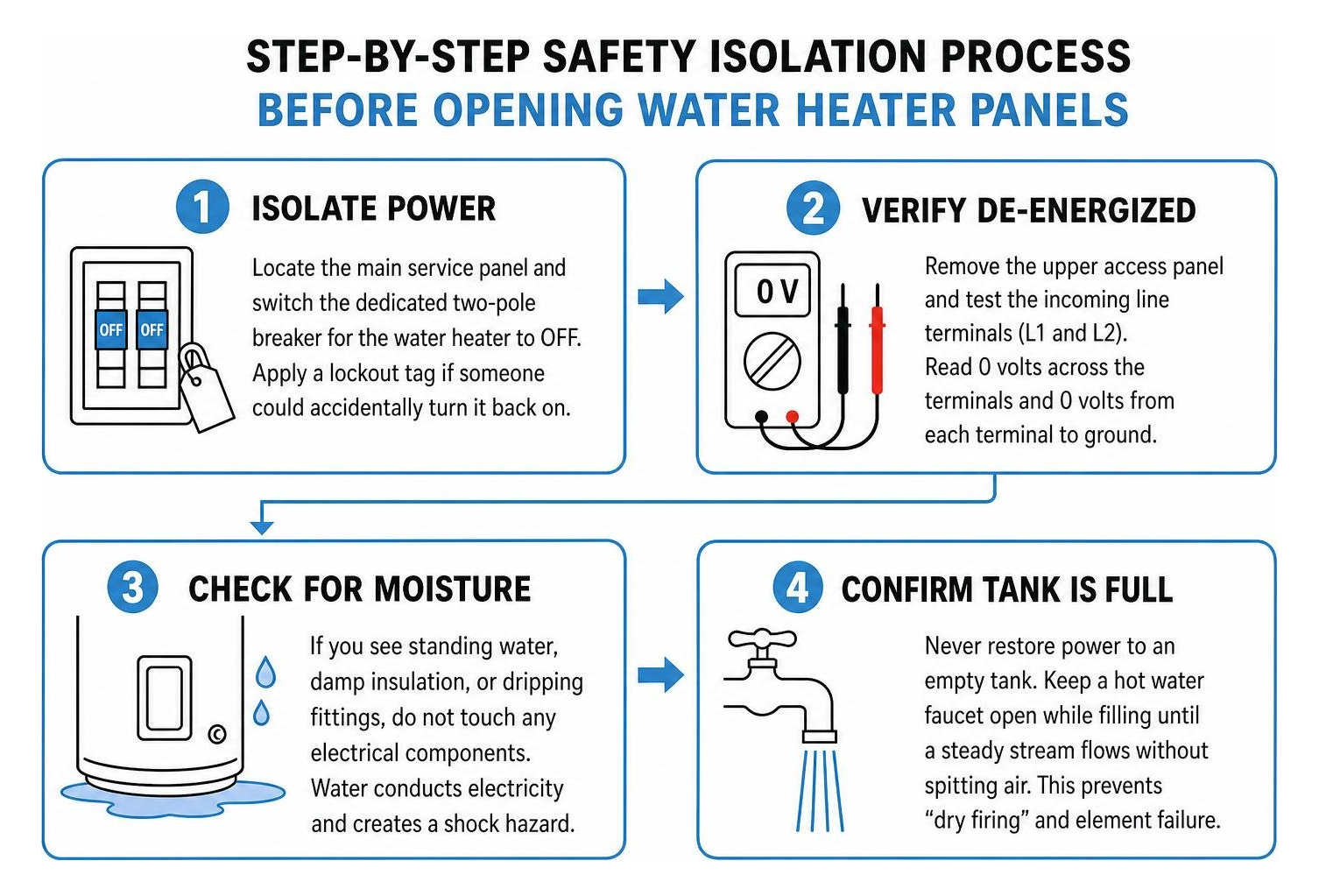
Before you troubleshoot any electric water heater problem, use this quick safety checklist:
- Turn off the correct breaker. Switch the two-pole water-heater breaker to OFF at the electrical panel. Do not rely on a handwritten panel label alone.
- Confirm the power is off. Use a properly rated meter or voltage tester to verify that the incoming terminals are de-energized before touching wires or components. If you are not comfortable using electrical test equipment, stop here and call a qualified professional.
- Keep water away from electrical parts. Do not open panels if there is standing water, wet insulation, a leaking fitting, or moisture around the wiring.
- Never energize an empty tank. If the tank was drained, refill it completely before turning the breaker back on. Open a hot-water faucet until water flows steadily without sputtering to remove trapped air.
- Put covers and insulation back in place. Reinstall the plastic shield, insulation, and metal access cover before restoring power.
A tripped breaker, melted wire insulation, repeated reset-button trips, or an active leak are all signs to stop DIY troubleshooting and arrange professional service. If corroded supply lines, leaking shut-off valves, or worn connectors are part of the problem, our plumbing fixture services can help secure the surrounding plumbing safely.
Electric Water Heater Has No Hot Water or Keeps Tripping the Breaker
No hot water, lukewarm water, or a breaker that will not stay on usually points to a power-supply problem, a failed heating element, or a thermostat issue. Most standard tank-style electric water heaters have two thermostats and two heating elements. The upper controls the upper part of the tank first, then sends power to the lower controls once the top is hot.
Start with the simple checks before testing components.
Check the Breaker and Reset Button First
If the water is completely cold:
- Check the dedicated water-heater breaker. If it is tripped, reset it once.
- If it trips again immediately, leave it off. Repeated trips can signal a shorted element, damaged wiring, or a failing breaker.
- With the power shut off and verified off, remove the upper access cover and look for the red high-limit reset button on the upper thermostat.
- Press the button firmly. If it clicks, reinstall the insulation and cover before turning the breaker back on.
The red button is an Energy Cut Off (ECO) safety switch. It is not meant to be reset over and over. If it trips again, a thermostat or heating element may be overheating the tank and needs professional diagnosis.
Test the Heating Elements With the Power Off
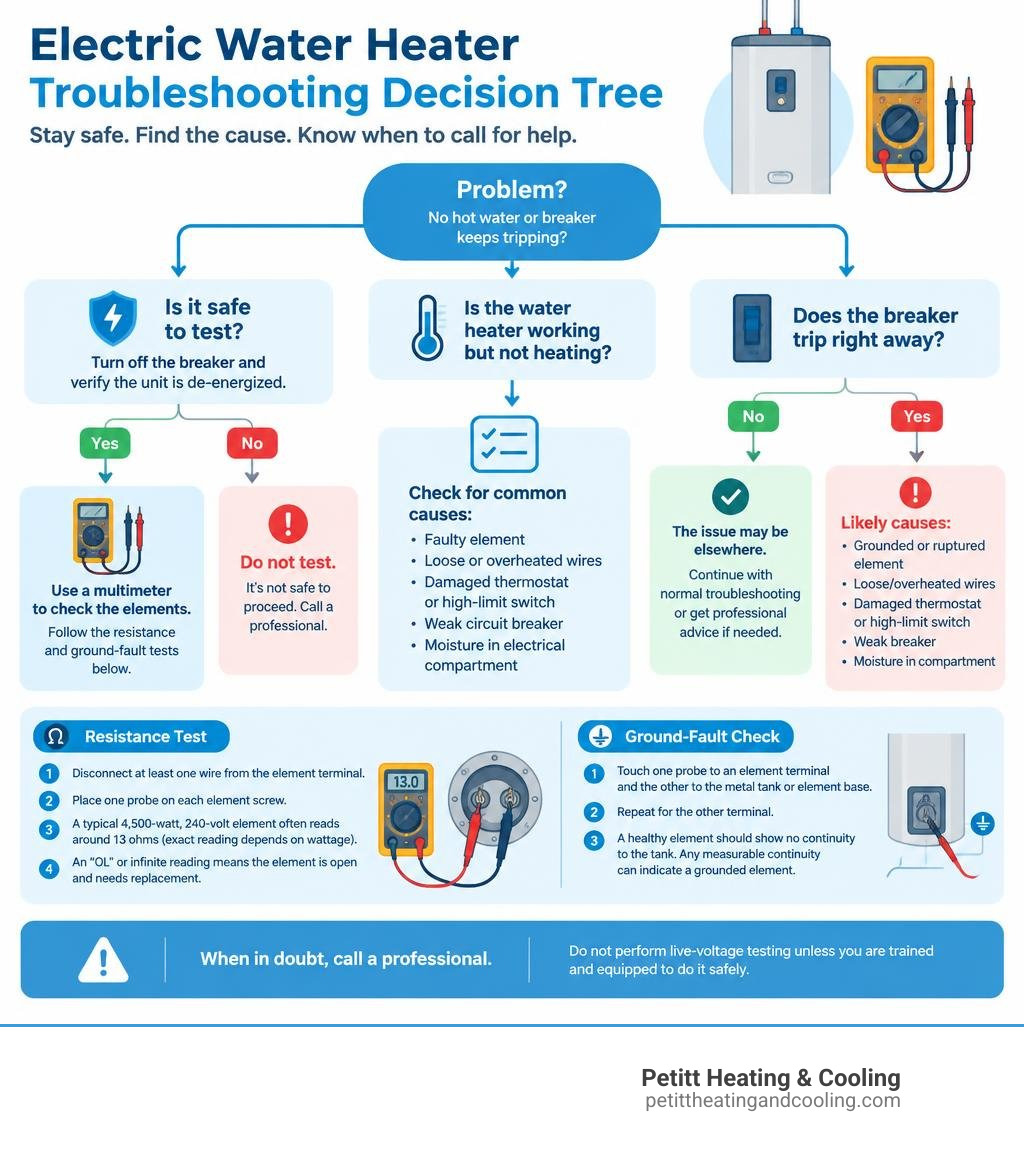
A multimeter can help you identify an open or grounded element, but only work with the breaker off and the unit verified de-energized.
For a basic resistance test:
- Disconnect at least one wire from the element terminal so you are testing the element by itself.
- Put one meter probe on each element screw.
- A typical 4,500-watt, 240-volt element often reads around 13 ohms. The exact expected reading depends on the wattage listed on the element.
- An
OLor infinite reading usually means the element is open and needs replacement.
For a ground-fault check:
- Touch one probe to an element terminal and the other to the metal tank or element base.
- Repeat for the other terminal.
- A healthy element should show no continuity to the tank. Any measurable continuity can indicate a grounded element.
Do not perform live-voltage testing unless you are trained and equipped to do it safely. A thermostat that will not switch properly, a damaged wire, or uncertain meter readings are good reasons to call a technician.
Why the Breaker Keeps Tripping
A water-heater breaker that trips right away is not something to force back on. Common causes include:
- A grounded or ruptured heating element that is shorting to the tank
- Loose or overheated wire connections behind an access panel
- A damaged thermostat or high-limit switch
- A weak circuit breaker that needs evaluation by an electrician
- Moisture inside the electrical compartment from a leak or condensation problem
If the elements and connections look questionable, or the breaker trips as soon as power is restored, stop troubleshooting. Our guide to knowing when to call a plumber can help you decide when it is time for professional support. If you also suspect a hidden plumbing leak, watch for unexplained use and unexpected water bill increases.
Water Heater Makes Popping Noises or Runs Out of Hot Water Too Fast
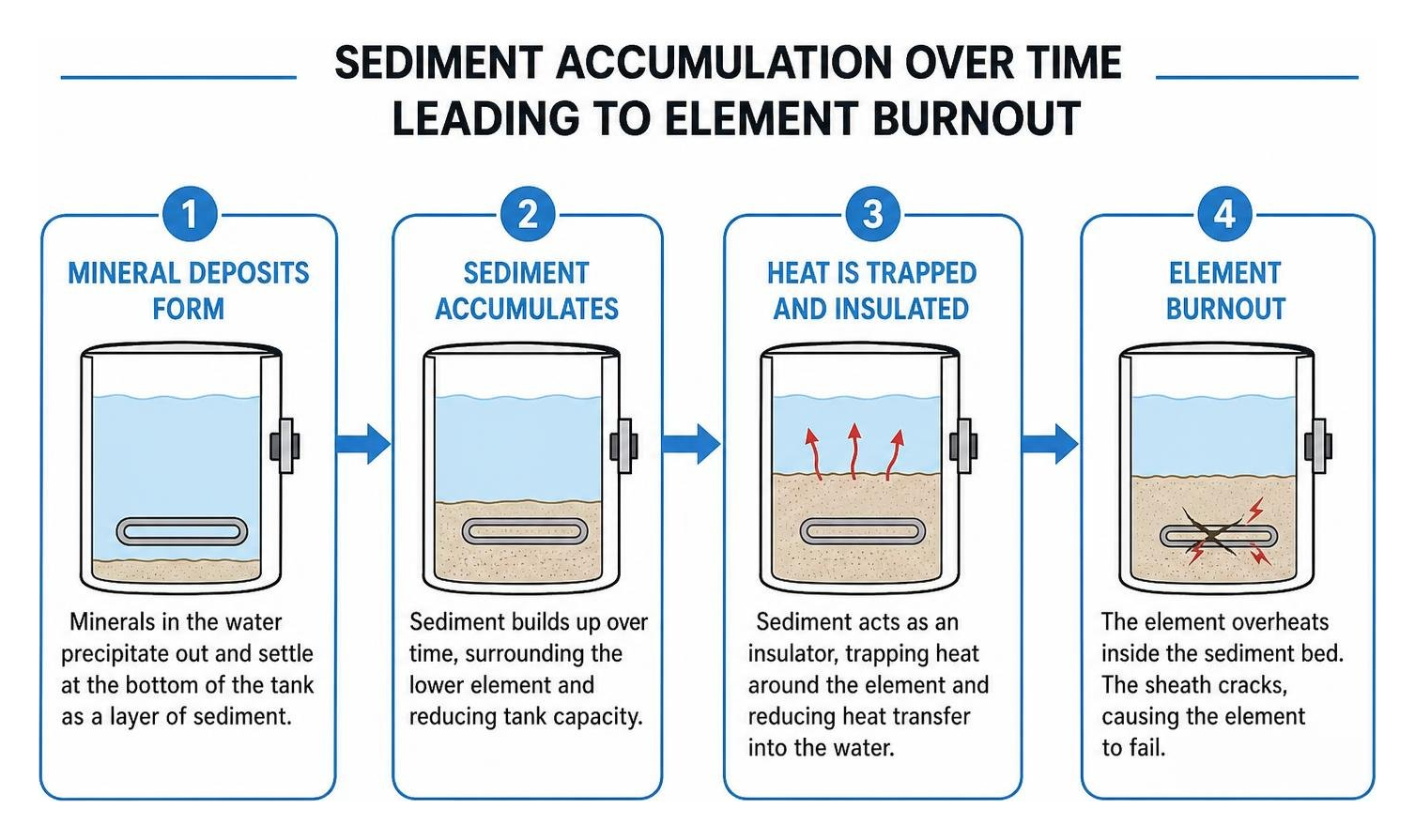
If you hear popping, crackling, or rumbling from the bottom of the tank—or your shower turns cold much sooner than it used to—sediment may be taking up space and trapping heat around the lower element.
Minerals in the water can settle at the bottom of the tank over time. This buildup can:
- Reduce the amount of hot water the tank can hold
- Make the water heater noisier as water heats beneath the sediment
- Force the lower heating element to work harder
- Shorten the life of the element, especially in hard-water areas
Learning about the impact of hard water on appliances can help you decide whether a water-quality solution should be part of the long-term fix.
How to Flush Sediment From an Electric Water Heater
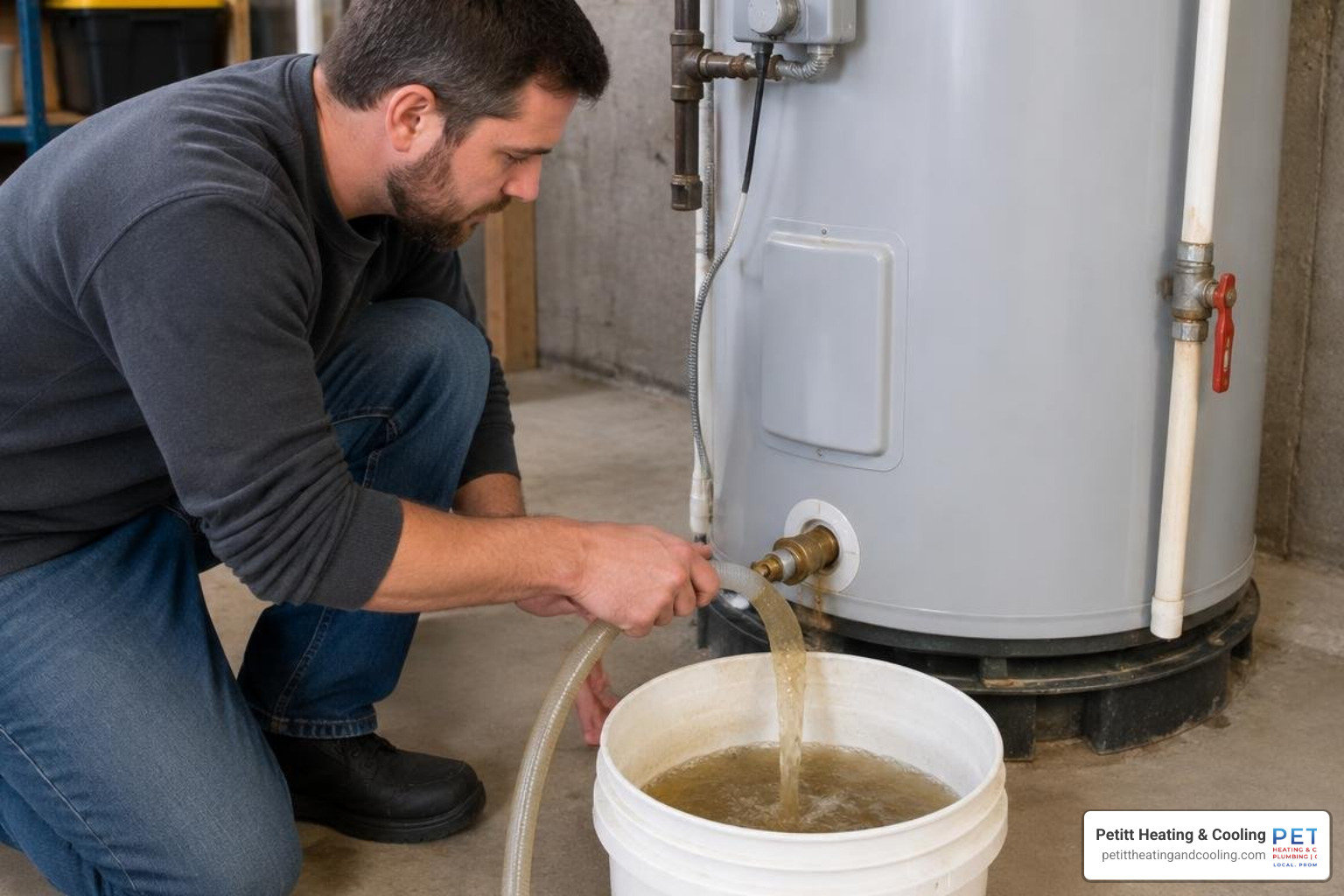
A yearly flush can help remove loose mineral buildup. If the drain valve is clogged, the tank is heavily scaled, or you are unsure about the condition of the valve, have a plumber handle it instead.
- Turn off the power. Switch off the water-heater breaker.
- Let the water cool if needed. This reduces the risk of scalding.
- Connect a garden hose. Attach it to the drain valve at the bottom of the tank and route the other end to a safe drain location.
- Shut off the cold-water supply. Close the valve above the tank.
- Open a hot-water faucet. This lets air into the system so the tank can drain more easily.
- Open the drain valve slowly. Let the tank drain, watching for cloudy water or sediment.
- Rinse out remaining debris. Briefly open the cold-water supply in short bursts while the drain remains open, until the discharge runs clearer.
- Close the drain valve and refill the tank. Keep a hot-water faucet open until the water flows smoothly without air.
- Restore power only after the tank is full. Turning power on before the tank refills can burn out an element.
For a more complete inspection of the tank, relief valve, electrical connections, and surrounding plumbing, schedule routine plumbing maintenance.
Water Heater Is Old, Leaking, or Not Worth Repairing
A failed element or thermostat does not automatically mean you need a new water heater. On a younger tank with no leaks or serious corrosion, replacing a serviceable part can be a practical repair. But once the tank itself begins to fail, replacement is usually the safer investment.
Use this simple comparison to guide your decision:
| If you are seeing this issue | Repair may make sense | Replacement is usually the better choice |
|---|---|---|
| Tank age | Under about 8 years old | Around 10–12 years old or older |
| Problem | One failed element, thermostat, or loose connection | A leaking tank, rust at the bottom, or recurring major failures |
| Tank condition | No signs of corrosion or water around the base | Water coming from the tank body or visible rust-through |
| Maintenance history | Tank has been flushed and is otherwise in good shape | Heavy sediment, poor performance, and repeated repairs |
| Long-term goal | Restore reliable hot water at a lower upfront cost | Improve reliability, efficiency, and warranty protection |
When a Repair Is Reasonable
Repair is often worth considering when:
- The tank is relatively new
- A meter test confirms a single failed heating element
- The thermostat or reset switch is defective
- There is no water leaking from the tank body
- Wiring and electrical connections are in safe condition
If you replace an element in a hard-water home, ask about low-watt-density or fold-back elements. They can be more resistant to scale-related overheating than standard straight elements.
When You Should Replace the Water Heater
Plan for replacement if you notice:
- Water leaking from the bottom or side of the tank
- Rust-colored water paired with corrosion around the tank
- Frequent repair calls or repeated electrical problems
- A tank near or beyond its expected service life
- Not enough hot water even after repair and maintenance
If replacement is the right move, comparing tank vs tankless water heaters can help you weigh the best option for your household. Petitt Heating & Cooling also provides professional water heater services for properly sized replacement and installation.
Common Electric Water Heater Problems: Quick Answers
Why does the reset button keep tripping?
The red reset button trips when the upper thermostat senses unsafe water temperatures. A stuck thermostat, grounded heating element, or wiring problem can cause it to trip.
You can reset it once after safely turning off the breaker. If it trips again, leave the power off and arrange service. Repeatedly resetting the ECO switch can hide a problem that needs to be fixed.
How long do electric water heater elements last?
Element life varies with water quality, maintenance, and usage. Hard water and heavy sediment can shorten element life, while regular flushing and water treatment can help reduce scale buildup.
If your home has recurring scale problems, comprehensive water quality services may help protect both the water heater and other plumbing fixtures.
Should I replace one heating element or both?
If testing clearly identifies one failed element and the tank is in good condition, replacing that element can be enough. Replacing both elements may be worth considering when:
- The water heater is older
- Both elements have been exposed to heavy sediment
- You are already draining the tank for service
- The second element shows signs of wear or questionable readings
A technician can help you decide whether replacing one part, both elements, or the entire unit offers the best value for your tank’s condition.
Still Having Electric Water Heater Problems? Get Reliable Help
Most electric water heater issues fall into a few familiar categories: no power, a tripped reset switch, a failed element, sediment buildup, or an aging tank. A calm, step-by-step approach can help you identify the likely problem without taking unnecessary risks.
Here is the simplest next-step guide:
- No hot water: Check the breaker and reset switch, then have components tested if the issue continues.
- Breaker keeps tripping: Leave the breaker off and call for service.
- Popping noises or short hot-water supply: Consider a tank flush and evaluate hard-water buildup.
- Tank is leaking or badly rusted: Plan for replacement rather than another component repair.
When you would rather leave 240-volt diagnostics, maintenance, or replacement to an experienced technician, Petitt Heating & Cooling is ready to help. We offer a $500 installation guarantee, a 10-year parts-and-labor warranty on qualifying systems, and a 12-hour priority response window for critical home-system failures.
For help with troubleshooting, maintenance, or replacement, contact us for expert plumbing services.